



Photovoltaic Products
PV Cell Screen Printing Line
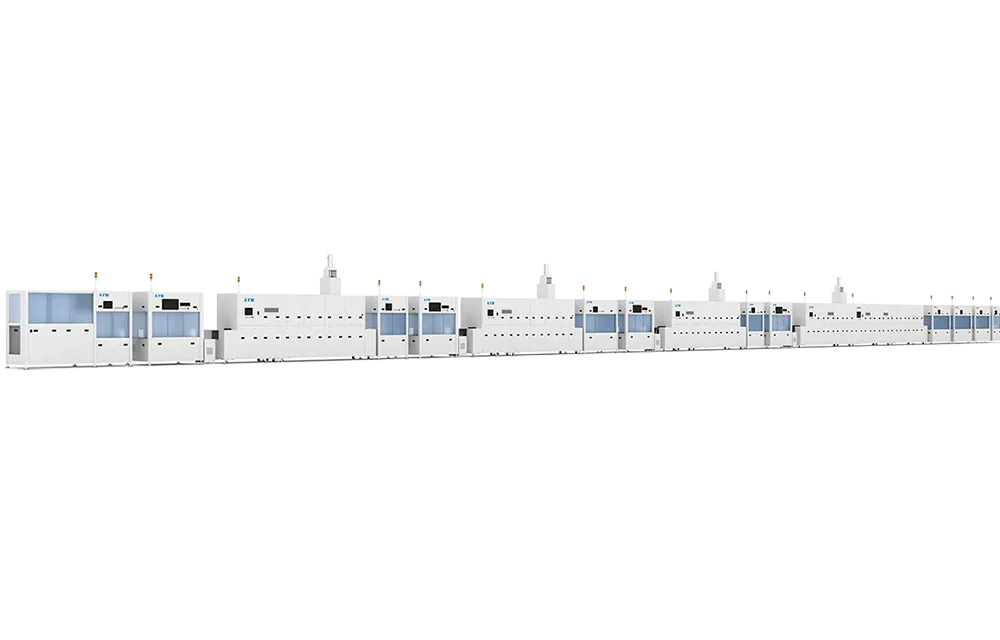
PV Cell Screen Printing Line plays a vital role in the manufacturing of crystalline silicon solar cells. It is designed to print conductive pastes, such as silver and aluminum paste, onto the wafer surface using a precision screen printing plate, forming the front fingers and busbars, as well as the back electrode. The printed structures are then fired to create ohmic contacts and current collection structures.
-
CT
0.7s@182*182 Cell
This modern printing line is fully automated and integrates multiple stations, typically including loading, buffer, alignment, multi-pass printing (two passes on the front and two on the back), vision inspection, sorting, and unloading modules. Its core components include the high-rigidity printing platforms, CCD-based alignment systems with micron-level precision, servo-driven squeegee units, automatic paste supply systems, and an intelligent process control system. The line supports advanced technologies such as SMBB (Super Multi Busbar), 0BB (Zero Busbar), and fine-line printing (line width ≤25μm).
Technological Advantages
Ultra-high printing accuracy and repeatability (accuracy ≤±6 μm, line width control capability down to 20–30 μm), high capacity and flexible manufacturing (4800–5200 pcs/h), and intelligent operation with yield assurance (integrates AI-powered AOI).
Key Parameters- Suitable for 182mm (M10) to 210mm (G12) cells
- Supports rectangular cells and half-cut cells
- Cell thickness: 100–180 μm (customizable down to 80 μm)
- Printing passes: 2 on front (fingers + busbars) and 2 on back (fingers + busbars)
- Printing accuracy: ≤±6 μm; line width uniformity: ±2 μm
- Minimum line width: 20–25 μm (depending on paste and plate)
- Capacity: 4800–5200 pcs/h (182mm)
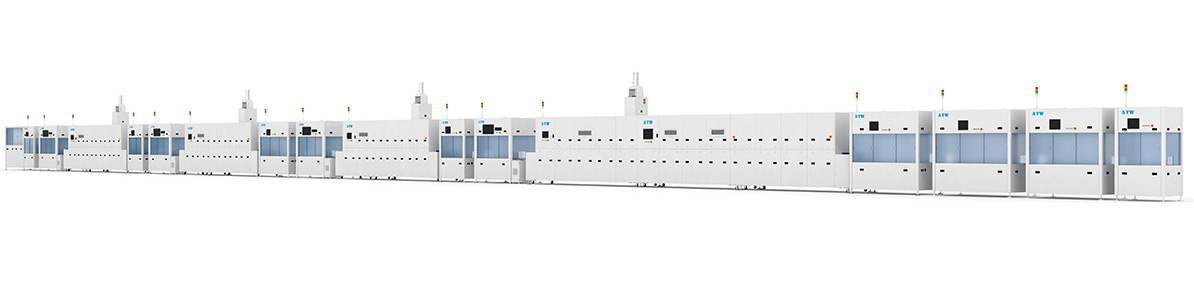
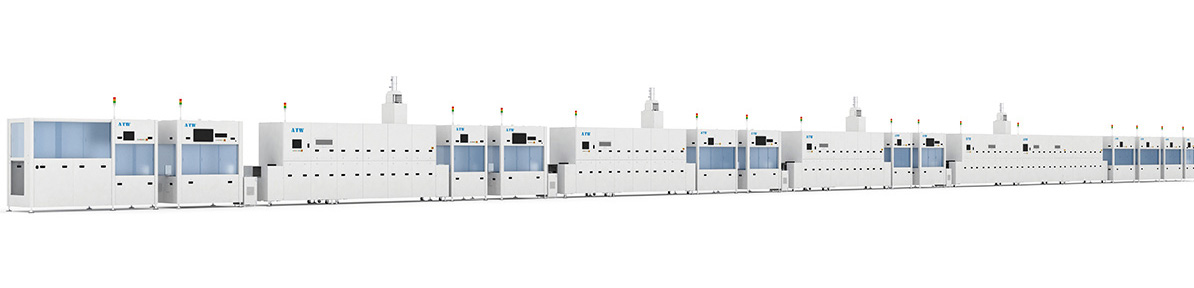
One line covering the whole printing process
The screen printing line includes printing, drying, firing, annealing, sorting and inspection.
-

 Super short cycle time
 -

 High precision
 -

 Strong expandability