


How Global PV Manufacturers Evaluate Equipment Suppliers Today?
FEB. 20, 2026
Key Points
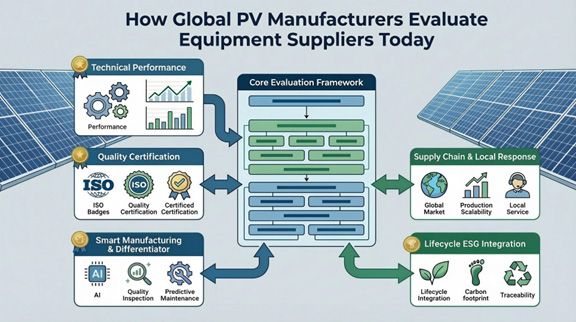
1. Market Growth: The global PV equipment market is projected to grow at a CAGR of 10.4% from 2026 to 2035, per the Business Research Insights 2026 report.2. Core Evaluation Framework: Supplier selection now centers on five key dimensions: technical performance, quality certification, production capacity, globalized local service, and ESG compliance.
3. Smart Manufacturing as a Differentiator: AI-driven quality inspection and predictive maintenance have emerged as critical differentiators, augmenting traditional technical assessments.
4. Lifecycle ESG Integration: Beyond a mere market entry requirement, ESG compliance—specifically carbon footprint certification and traceability—is now integrated into the entire supplier lifecycle.
5. Supply Chain & Local Response: In an era of rapid capacity expansion, a supplier’s production scalability and local service responsiveness are vital for ensuring timely project delivery.
Introduction
Per IRENA’s 2024 Solar PV Supply Chain: Technology and ESG Standards, the global PV industry is in structural transformation. Global new PV installations are forecast to hit 540-660 GW by 2026, growing steadily from 2025. This expanding installed capacity is pushing manufacturers to ramp up production, raising higher requirements for equipment suppliers’ capacity assurance. Meanwhile, the accelerated global energy transition is shifting manufacturers’ focus from pure price competition to a comprehensive evaluation system, covering technical performance, quality certification, supply capacity, global localized services and ESG compliance. This shift mirrors the industry’s maturity and the growing demand for resilient, sustainable supply chains amid the energy transition.I. Technical Performance: The Core of an Equipment Supplier's Strengths
1.1 R&D Investment and Innovation CapabilityATW devotes itself to technological R&D and consolidates its core competitiveness: our company currently has 1,237 R&D professionals, accounting for 29% of the total workforce, a proportion that ranks high in the industry. We have secured a total of 2,361 intellectual property rights, forging a solid and profound technological foundation. In the first three quarters of 2025, the company’s R&D investment accounted for 7.6% of its revenue, placing it at the forefront of the photovoltaic equipment industry, with R&D expenditure exceeding CNY 200 million in the first half of 2025 alone. The continuous increase in R&D investment enables ATW to accurately respond to market changes, rapidly launch new products and technologies that meet customers’ needs, and drive business development through technological innovation.
1.2 Core Technical Indicators and Performance Advantages
The core technical indicators of equipment are the direct embodiment of technical performance, and are directly linked to production efficiency and product quality. Multiple core products of ATW lead the industry in key technical indicators, with our stringers holding a strong global market share of approximately 70%, a testament to their exceptional market performance.
• Low-oxygen monocrystalline furnace:
Oxygen reduction upgrade;
Ingot oxygen content reduced to 8-9ppm;
One-click intelligent crystal pulling system enables full-process automation from feeding, crystal pulling to finishing;
The new-generation soft control system, based on ATW digital twin technology, empowers the upgrade to unmanned smart factories.
• Wafer sorter:
20,000 whole wafers/hour
Compatible with 182~230 mm specifications
Dual compatibility with whole and half wafers
Chip breakage rate ≤ 0.1%
Exclusive adoption of near-infrared long-wave + InGaAs image sensor
Pioneering pinhole detection function
Combination of AI intelligent algorithm and traditional technology
• PV Cell Screen Printing Line:
Linear interactive printing for higher speed, with a CT of ≤ 0.7s for 182 cells;
High expandability, retrofittable for half-cell printing;
The new-generation linear printing line for whole/half cells delivers higher productivity and precision.
• High-speed stringer for photovoltaic modules:
Productivity ≥ 12,000 small cells/hour
Adaptable to half, third and quarter cells of different specifications
Compatible with various high/medium/low temperature 0BB processes
Support for both long and short cell strings
Enable conventional and high-density module manufacturing processes
The leading advantages of these technical indicators help customers greatly improve production efficiency, effectively reduce manufacturing costs and continuously enhance market competitiveness.
1.3 Hardware-Software Integrated Smart Manufacturing

ATW provides professional software services via its subsidiary Weint, and occupies a leading position in the field of smart manufacturing.
ATW’s diverse and innovative applications in smart manufacturing mainly include:
AI-powered intelligent crystal pulling system: Integrating AI and vision inspection technologies, it enables precise control over temperature and gas convection, and stably realizes full-process automation covering loading, crystal pulling and final finishing. Relying on innovative heating methods and a proprietary furnace structure design, the equipment optimizes dynamic and static thermal fields to effectively improve crystal quality, reducing the crystal oxygen content to 8–9 ppm. It solves the problems of concentric circles and black wafers caused by excessive oxygen content in silicon wafers, and significantly boosts product yield. With its advanced oxygen reduction process and intelligent crystal pulling system, ATW’s Monocrystal Ingot Puller has been widely recognized by leading enterprises in the industry at home and abroad, including JinkoSolar and Trina Solar, with total sales exceeding 5 billion yuan. ATW can also provide customers with customized automated crystal pulling production line solutions, helping crystal pulling workshops achieve intelligent operation and integrated management, and further driving cost reduction and efficiency improvement for clients.
Stringer Health Management System: Developed based on equipment design principles and big data-driven AI algorithm models, this system integrates real-time operation data of equipment and establishes a dedicated knowledge base for faults and defects. It helps reduce reliance on manual professional skills, shorten troubleshooting time and cut down downtime.
Taking a 2GW module workshop as an example, the system has delivered remarkable results after application: it saves 1 hour of complex fault troubleshooting time and 30 minutes of defect-related downtime troubleshooting time per day, and reduces downtime incidents by 12 times per month, greatly enhancing the overall operational efficiency of the workshop.
II. Quality Certification: Compliance and Reliability Guarantee
ATW has established a comprehensive compliance management system covering the entire product lifecycle, ensuring that every piece of equipment we deliver meets the highest global standards of quality, safety, and reliability.Full Lifecycle Compliance Management: We have built a robust compliance framework that spans from R&D and design to production, delivery, and after-sales service, strictly adhering to international quality and safety benchmarks.
International Management System Certifications: We hold globally recognized certifications including ISO9001 (Quality Management), ISO14001 (Environmental Management), ISO45001 (Occupational Health and Safety Management), and ISO50001 (Energy Management), which form the cornerstone of our operational excellence.
Key Domestic Qualifications: We possess critical domestic credentials such as the Integration of Informatization and Industrialization Management System, Enterprise Intellectual Property Compliance Management System, and Safety Production Standardization, ensuring our operations are standardized, intelligent, and sustainable.
Global Product Certifications: Our products have passed rigorous testing and obtained authoritative certifications from leading European and American bodies, including TÜV, Intertek, CSA, and SGS, enabling seamless market access and providing our overseas customers with unwavering compliance assurance.
Systematic Certification Development: We have implemented a structured certification development process from concept design to mass production, supported by a dedicated team of certification engineers who provide end-to-end expertise. This ensures that every piece of equipment leaving our facilities is of stable, reliable quality.
Backed by this robust compliance framework and a comprehensive portfolio of certifications, ATW solidifies the quality foundation of our production and delivery. We are committed to providing global customers with stable, reliable, and fully compliant equipment and services, driving the high-quality development of the industry.
III. Supply Capability & Production Capacity: Supply Chain Resilience Guarantee
ATW, as an industry leader, boasts large‑scale, efficient and sustainably stable production and delivery capabilities. We have built a global production layout and supply chain system, and consolidated supply chain resilience with strong manufacturing strength.The company has deployed 19 modern production bases across China, providing solid support for large‑volume, high‑quality and on‑time delivery. Meanwhile, we actively promote the global deployment of production capacity and have built an overseas production base in Malaysia, which is close to key overseas markets and further improves regional supply efficiency and delivery flexibility.
Relying on our global operation system, ATW has established a subsidiary in the United States and set up localized sales and service centers in key regions including Portugal, India, Japan and Singapore.
This forms a complete layout of "domestic + overseas” dual manufacturing bases and "global multi‑point” coordinated sales and services, enabling us to quickly respond to the needs of global customers, ensure long‑term stable supply, and provide reliable support for customers’ project implementation and capacity ramp‑up.
IV. Globalized Local Service Capability
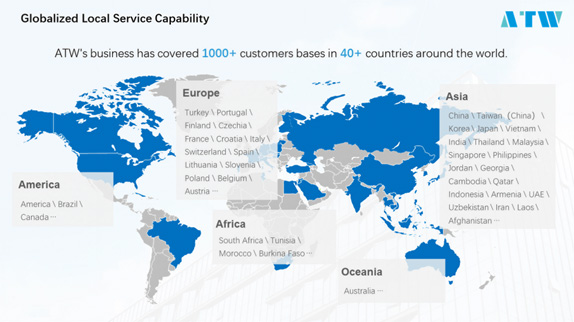
ATW has built a global localized service network, with its business covering more than 40 countries and serving over 1,000 customer bases across the Americas, Europe, Asia, Africa and Oceania.Leveraging our leading position in core sectors including photovoltaic, energy storage and power semiconductors, we serve more than 95% of PV enterprises, over 70% of energy storage enterprises and more than 55% of power semiconductor packaging and testing enterprises in the industry, and have established in-depth partnerships with global leaders such as JinkoSolar, Trina Solar and LONGi.
With more than 10 years of global service experience, we provide on-site support at over 390 customer locations worldwide and possess 4,532 equipment service capabilities. Committed to a 7×24-hour response, we deliver professional after-sales support in both Chinese and English, together with complete technical documentation.
In addition, the high global market share of our core products, extensive penetration in overseas markets, and a supply chain based on international standard parts enable customers to access technical support and spare parts more efficiently, ensuring smooth operation and maintenance as well as stable production.
V. ESG Compliance: Inevitable Requirement for Sustainable Development
ATW actively upholds the ESG philosophy, pays close attention to environmental changes, and promotes sustainable development through technological innovation.As of June 30, 2025, the photovoltaic equipment supplied by the company has helped generate more than 1.4 trillion kilowatt-hours of solar power globally, equivalent to saving over 427 million tons of coal and reducing carbon emissions by more than 1.154 billion tons. We are contributing to the global carbon neutrality goal with concrete actions.
In terms of product life cycle management, ATW’s wafer sorter has obtained the 018 carbon footprint certification and become an industry benchmark. In 2026, ATW also plans to apply for carbon footprint certification for its stringers, to continuously advance green manufacturing and low-carbon development.
Conclusion
In summary, global PV manufacturers have shifted their evaluation of equipment suppliers from a traditional focus on price and technical parameters to a comprehensive assessment system centered on technical performance, quality certification, supply and production capacity, global localized service capabilities, and ESG compliance.As an industry leader, ATW (Wuxi Autowell Technology) has become an ideal partner for global PV manufacturers through its comprehensive advantages in R&D innovation, production capacity, quality control, engineering services and brand influence, demonstrating strong technological innovation capability, stable production capacity and outstanding brand influence.
Faced with the rapid evolution of PV technologies and continuous changes in the market environment, manufacturers need to select equipment suppliers with long-term innovation capabilities, in-depth insights into industry trends, stable production capacity and high-quality services, so as to maintain a leading position in future competition.