



How Manufacturing Data Improves Yield and Process Stability
FEB. 14, 2026
As high-end industrial manufacturing enters the era of intelligence, data has evolved from a “byproduct” of equipment operation into a core enterprise asset. For manufacturers in the photovoltaic , lithium battery, and semiconductor industries, the ability to efficiently collect, analyze, and apply manufacturing data has become a key driver for achieving high yield and strong process stability.
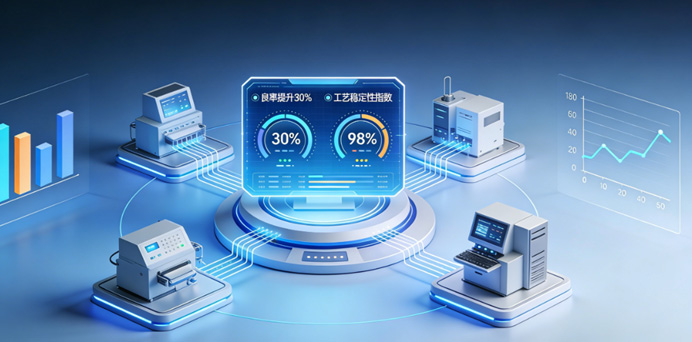
1. Real-Time Monitoring for Highly Stable Production Processes
Process stability is rooted in the consistency and reliability of equipment operation. Intelligent systems represented by the Equipment Health Management (EAM) platform utilize millisecond-level PLC data collection, enabling each machine to monitor over 20,000 data points.- Predictive Maintenance:
By continuously monitoring key indicators such as equipment status, alarms, OEE (Overall Equipment Effectiveness), component cycle times, and spare-part lifecycles—combined with quality analysis models and equipment vibration models—potential failures can be predicted before they occur.
- Rapid Response Mechanism:
Once an abnormality is detected, the system rapidly completes root-cause analysis and pushes targeted handling strategies and early warnings to operators, minimizing downtime and ensuring stable production line operation.
2. Piece-Level Traceability to Continuously Improve Yield
One of the greatest challenges in manufacturing is accurately identifying where defects occur. The Piece-Level Manufacturing Traceability System (MTS) records the full manufacturing life cycle of each individual product unit—including equipment status, process parameters, and quality inspection data—enabling fast issue closure.- Precise Traceability:
In PV cell production, each cell can be traced back to specific equipment, production batches, process recipes, operators, and even furnace tube temperature zones and real-time process parameters during production.
- Yield Recovery:
By correlating EL / IV performance and inspection data with historical process parameters, the system accurately identifies the process conditions responsible for defective or low-efficiency cells, enabling the elimination of specific process defects.
- Case Validation:
After implementing piece-level traceability, abnormal issue tracing time was reduced by 80%, and average cell conversion efficiency increased by 0.2%.
3. AI-Powered Process Optimization
When raw manufacturing data is processed through a Big Data AI Platform (ABP), its value is fully unlocked. The platform integrates EAP, MES, MTS, and data warehouse systems to establish a unified data asset framework.- Root Cause Analysis:
AI models perform in-depth analysis of process inspection data such as film thickness and sheet resistance, as well as complex issues including EL overkill and stringer failure prediction. This provides a scientific basis for process parameter adjustments. Through deep learning and adaptive optimization, the models can fine-tune process parameters and automatically distribute optimized settings to production equipment.
- Intelligent Control:
In the crystal growth process, the Intelligent Crystal Pulling (ICP) system uses AI models to predict seeding power and automatically determine optimal shoulder-finding targets. This reduces manual intervention by 16.03% and increases daily output by 4 kg per machine, significantly improving process stability and success rates.
4. Quantifiable Economic Value
The deployment of Manufacturing Operations Management (MOM) systems delivers measurable economic returns. Based on case studies from a 5GW PV cell workshop, data-driven manufacturing achieved the following results:Yield Improvement:
Main-grade concentration increased by 0.62%, while overall cell yield rose by 0.4%.
Breakage Reduction:
Blocking-related and breakage rates decreased by 20%.
Operational Efficiency Enhancement:
The system replaces manual inspection with automated checks (process error-proofing) and improves overall efficiency through abnormal alerts, automated statistics, and proactive control, resulting in a 3–5% increase in operational efficiency.
Cost Efficiency Optimization:
Through optimized diversion logic, proactive control, and poka-yoke mechanisms, production lines with complex packaging and shipment requirements can save approximately RMB 3 million per year in labor and operational costs.
Conclusion: The Future of Intelligent Manufacturing
The vision of a factory where "Data Creates Value” is no longer theoretical. By building all-dimensional data models and implementing full-process AI management, manufacturers can achieve not only faster production but also more stable and reliable manufacturing capabilities.As enterprises advance toward the Smart Factory, the depth of manufacturing data ultimately determines the height of competitive advantage.